Showing posts with label Roadside America. Show all posts

August 18, 2012

The El Trovatore: Beacon of Light and Hope

The magnificent 100-foot neon tower at sunrise.

Route 66 travelers who chase the sunset into the city of Kingman, Arizona, compare the experience with a long, slow airplane descent. The lights of distant motels and restaurants beckon travelers for miles, and those lights grew a little bit brighter this year thanks to the efforts of Sam and Monica Frisher.

This spring the Frishers accomplished a feat that I never dreamed possible: restoring the battered El Trovatore Motel and its spectacular 100-foot neon tower. Built in 1937 as a service station on a stony bluff, the tourist court was added in 1939 and offered travelers stunning views of the Hualapai Mountains to the east. Its first owner was John F. Miller, who famously built the first hotel in Las Vegas, Nevada, the Sal Sagev (Las Vegas spelled backwards). When Route 66 was bypassed, the El Trovatore fell into disrepair and eventually became apartments.

On a warm May night I arrived via Andy Devine Avenue and immediately savored the motor court's pre-World War II atmosphere. Sam and Monica greeted me warmly and I unloaded my things into the Marilyn Monroe room before returning to the office to snap pictures of the Frishers and their dog Taco. Sam agreed to keep the neon tower lit until morning so I could view its glorious colors in the pre-dawn light (click photos to enlarge).

The Marilyn Monroe room: simple and comfy.
For 20 years I'd passed this old jewel of the desert and dreamed that a savior would one day restore her midcentury glory. Thanks to the Frishers, the dream is coming true. The soaring red and green neon tower was re-lit in March and 20 rooms have already been refurbished in old-school Hollywood themes. Eventually the entire motel will be restored; with so much open space, it's an ideal overnight stop for tour buses from Vegas and Laughlin. Sam is also planning an observation deck that will treat guests to a panorama of the Hualapai mountains and the parade of BNSF trains in the cut below. To book a room, visit their website at http://ElTrovatoreMotel.com.

Sam and Monica Frisher in the motel office, May 2012
 The Frishers have already overcome tremendous odds by saving the El Trovatore and these images are a tribute to their vision. These are the road warriors who keep the spirit of Route 66 alive, preserving the Mother Road as a lifeline for those seeking the true character of America, far from generic chains and interstates. Spend an evening with Sam and Monica at the El Trovatore and you'll quickly spot the qualities that make Route 66 special: individuality, community, and a bold vision of what lies around the next bend.

A guest's view of the neon tower. The LED lighting is temporary.

Only on Route 66 can you get a welcome like this!

The Frishers' dog Taco provides some evening entertainment.

April 17, 2012

Route 66 Beacons in the News

The classic 66 Motel in Needles: will she beckon travelers again?
Two landmark Route 66 motels are in the news: the El Trovatore in Kingman, Arizona, which has not only reopened but restored its neon tower, and the 66 Motel in Needles, California, which is the subject of an intense fundraising effort to save its classic sign.

Relighting the 66 Motel: There's a reason why most tourists drive to Laughlin instead of Needles, but the Route 66 town will always be my first choice. Between 100 BNSF trains a day, the nearby Colorado River, a Harvey House hotel and a parade of vintage motels and diners, Needles has plenty to interest the Route 66 traveler. Now preservationist Ed Klein is raising money to restore the classic 66 Motel sign in Needles, Calif. I last photographed the sign in 2004 while working on my Route 66 Railway book (back then I was still shooting film!). For as much as it's been immortalized in books, documentaries and artwork, this is the first serious restoration effort I can recall. Ed's goal is to raise $3,600 by 11:59 p.m. PT on Wednesday, April 18; about 35 hours remain as of this posting. Click HERE to see a 90-second video on the restoration and donate online. (Donors get cool Route 66 perks!)

Can you imagine this lit up at dusk?
A Southwest Beacon Returns: I've lost count of how many times I passed the hillside El Trovatore motel and prayed that a savior would one day restore its midcentury glory. Thanks to Monica and Sam Frisher, that prayer has finally been answered. The soaring red and green neon tower was relit in early April and 20 rooms have been refurbished in classic Hollywood themes. A ton of work remains, but the Frishers have already overcome huge odds by saving this Kingman gem. I can't wait to visit and capture that marvelous tower at dusk . . . hopefully there's a way to frame the motel with a passing train in the cut below. For more info, visit their website at http://eltrovatoremotel.com/. You can read a great article on the motel restoration by clicking HERE. Also, author Jim Hinckley has photos of the restored tower -- click HERE to see them.

A big "thank you" to these preservation heroes who are keeping the Route 66 mystique alive!

January 22, 2012

Paddock Bowl Neon

Before I post yet another series of Monterey Bay sunset photos -- see the last two posts -- let's do something different. Above is a marvelous neon sign found near Concord, California in the East Bay area. I was driving home from Martinez in April 2010 and spotted this bowling alley next to Interstate 680. The ball "rolls" into the pins thanks to a cool lighting sequence. Love those colors! (click to enlarge)

October 14, 2011

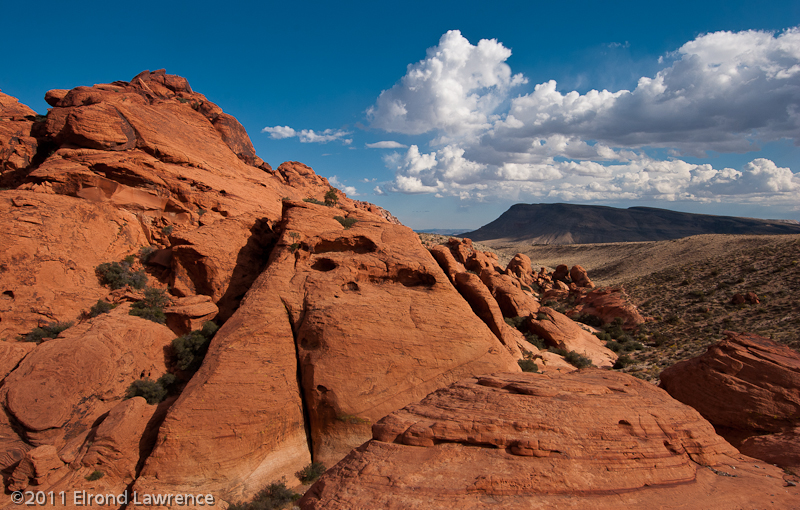
Red Rock Canyon


By now it may seem like this blog is going to be a once-a-month affair (at best), but have faith, my handful of followers . . . I'm learning to set aside the "epic-article" mindset and speed up the pace. Case in point: today's post.

Saturday, October 1st was an eventful day: it launched my new era as a full-time employee of HRmarketer.com, a firm I've worked with part-time since August 2003. (Two words: paid vacation.) It was also the start of a trip to Las Vegas for a HR technology conference, and we kicked things off with an afternoon road trip to Red Rock Canyon. Amazingly, this short but scenic canyon is only 20 minutes west of the Strip, and is well worth a visit. Below are a handful of snapshots from the colorful afternoon. Watch for a larger Facebook gallery coming soon. (Click pics to enlarge)

Last light on red rocks
Dodging shadows
Joshua tree and red rocks
Shadows and light
Thunderheads across the desert
Tree and panorama
A friendly park volunteer takes an exit survey.


August 1, 2011

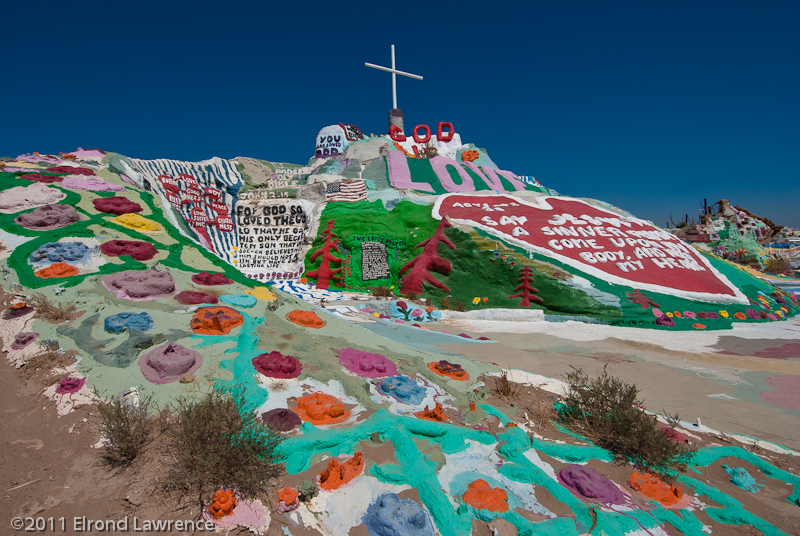
Salvation Mountain

While preparing for our June visit to the Salton Sea (see last post), I learned about a desert attraction that we just had to visit: Salvation Mountain, a three-story tribute to God near the tiny railroad junction town of Niland. Salvation Mountain is the creation of 79-year old Leonard Knight, who came to this place in 1984 and has been expressing his intense love for God ever since.

The theme of "love" is apparent up and down the mountain, from biblical scripture and the Sinner's Prayer to neon-colored flowers, waterfalls, and the Sea of Galilee at its base. A winding "yellow brick road" leads visitors to the summit, where they can stand beside a towering white cross and gaze across the Imperial County desert. Leonard himself still keeps regular hours at his masterwork to welcome guests and spread the word of God's love, although decades of toiling in a harsh environment are taking their toll on his stamina. But his passion and kind heart are still as vibrant as the colors that adorn his mountain.

(click photos to see full-size)

With plans to shoot trains along the Salton Sea in the late afternoon and evening, we settled for a midday visit. While the light wasn't ideal, we spent three wonderful hours touring the mountain and talking with Leonard and his friends who assist him with maintaining the adobe clay tower and keeping colors fresh . . . no small task, considering that summer temperatures can pass 120 degrees! Salvation Mountain was featured in Sean Penn's 2007 film Into the Wild, where Leonard appeared in a cameo role.

Leonard now lives in nearby Niland, but he can typically be found at the mountain during the midday hours (depending on heat severity). When we arrived on a 100-degree June day, he was being interviewed by a video crew but he quickly returned to his favorite role: happily welcoming visitors and answering questions. In the pictures above and below, Leonard is chatting with visitors from Switzerland; the lower image catches his trademark "thumbs up."


If you're touring the Salton Sea, Salvation Mountain is a must-see; it's located three miles east of Niland near Slab City. For more info, visit http://www.salvationmountain.us/. Below are a few assorted images from our visit.

Leonard's paint cans stand ready for touch-up work.

The winding "yellow brick road" that leads travelers to the summit.

 Viewed from inside the "museum," bluebirds soar across a skylight.

Trucks and other rainbow-colored vehicles add to the site's quirky character.

A final view of the Salvation Mountain mailbox. Thanks to Leonard and Daniel for their caring spirits!

June 3, 2011

Castroville Nights

Castroville street sign, 1/100 sec., f2.8, ISO 400

In late March I finally traded in my reliable-but-aging Nikon D70 body (six years' age is like dog years when it comes to digital!) and replaced it with a shiny new D7000. The difference was rather extreme. I'm still getting familiar with the D7K's dizzying array of features, but it's sure fun to handle. Best of all are the incredible low-light capabilities that allow handheld night shooting. Here are a few pictures from sleepy Castroville, California on a chilly March 25 evening, the first images shot by the new camera. ISO speeds range from 400 to 1250. It was amazing to wander Merritt Street, the town's main drag, and shoot at will with a 70-200mm lens and no tripod. (click thumbnails to enlarge)

Mariscos El Nayarita restaurant -- Edward Hopper's Nighthawks, Castroville style. 
1/80 sec, f3.2, ISO 1250

Street scene, 1/25 sec., f4.5, ISO 1250

Trolley Car Rotisserie, 1/20 sec, f2.8, ISO 640

Palenque Club, 1/50 sec., f2.8, ISO 400

Can't wait to give the D7K a serious shakedown cruise! A Salton Sea road trip is coming soon . . .


February 13, 2011

Central Coast Sunset

Sunset from Highway 1, January 28, 2011 (click photos to enlarge)

So far, 2011 has delivered an amazing winter. While much of the country is buried in snowdrifts, we're experiencing weeks of sunshine with temps frequently in the 60s and 70s (at this point I should duck to avoid the incoming fleet of snowballs). Since early January I've been driving to Kat's school near Watsonville to pick her up from drama rehearsals, and the timing for pictures couldn't be better: three times a week I pass through Moss Landing and neighboring Elkhorn Slough around sunset.

On one recent drive, the sky lit up with a dazzling show of color; the view was so hypnotic that I nearly drove into the slough! Coming to my senses, I pulled over to snap a few pictures (above). Glancing south toward Moss Landing, I spotted an exquisite scene in the gathering darkness (below). Layers of fog rose from the ground while a ribbon of cloud seemed to brush the smokestacks of the power plant.

Hmm, this winter thing isn't so bad in Monterey County . . .


January 21, 2011

Memories and Magic at Manzanar

In early October, the Lawrences piled into the Escape and took our first driving vacation down U.S. Highway 395. Amazingly, this California native had largely ignored U.S. 395 during the past four decades (many jaws have dropped when hearing this little factoid!). We started at Carson City, Nev., and ended in Hesperia, Calif, where the highway joins with Interstate 15. After driving the route from top to bottom in California, I stand at the roadside altar begging forgiveness. Highway 395 is a marvelous trip filled with staggering scenery and quirky towns, evoking many of the same thrills as Route 66. As time allows, I'll post mementos from our favorite stops: Bridgeport, Bodie, Bishop, Lone Pine and others.

Really, it's a no-brainer to choose the best day of the trip, the moment where U.S. 395 captured our hearts. North of Lone Pine, a deserted camp in the Owens Valley recalls one of the darkest times in America's history: Manzanar, a war relocation center where over 10,000 Japanese-Americans on the West Coast were interned during World War 2. Now a National Historic Site, Manzanar sports a visitors' center fashioned out of the old auditorium, along with replicas of the living quarters and a stirring memorial at the cemetery grounds, framed by the Sierra Nevada range (top photo -- click all photos to enlarge).

A rebuilt guard tower stands along the camp's eastern border, facing U.S. 395.

A stop at the visitors' center is highly recommended, but be ready to encounter a United States consumed by fear and racism. Be ready to face the raw emotions of a time when the Land of the Free singled out nearly 120,000 people, stripped them of their civil rights, and herded them into remote camps. Two thirds of all interned Japanese Americans were U.S. citizens by birth. But after Pearl Harbor none of that mattered. Political spin was as insidious in 1942 as it is today: survivors recall being told that the relocation was for their own "safety" . . . then upon arrival, they saw guard towers manned by military police with submachine guns, pointed inside the camp.

If the visitors' center doesn't move you, take the driving tour around the remains of the camp. Stop at the memorial and walk in silence as shadows spill across the Sierras. If you're lucky you'll encounter living history, as we did that October afternoon.

Grace Nakamura, Manzanar survivor

In a stroke of serendipity, we stumbled upon two replicas of the barracks buildings, reconstructed in 2010 to represent the living quarters of Manzanar internees. While exploring the barracks, we noticed a park ranger touring an elder Japanese couple. To our delight, ranger Carrie Andresen seized the moment and introduced us to her VIP guests: Grace and Yosh Nakamura, both survivors of internment camps.

Grace had lived in Manzanar, arriving as a teenager in May 1942. She told us how the family scrambled to take care of their belongings when the government ordered all Japanese Americans to evacuate the West Coast. A week later, they boarded a Southern Pacific train in Los Angeles with hundreds of evacuees; shades were drawn on the windows and no food or drinks were served. Her lasting image from that day was of a young family, the mother juggling two toddlers and baby twins -- all four crying -- and the father carrying two oversized suitcases with blankets and diapers strapped to his back.

Yosh and Grace pause at the entrance to a barracks replica.

Gesturing around the barracks, Grace explained the flimsy design of the original living quarters. Wind and dust were a constant presence, slipping through the tar paper and floorboards. Before linoleum and benches were installed, schoolkids sat on the floors and strained to see their fellow classmates through the dust. Grace's seven-member family included her younger brother, 12-year old Larry Shinoda, who became a camp sensation when he designed reclining back chairs for their mother and grandmother. Larry grew up to be a world-famous auto designer, best known for the 1963 Corvette Sting Ray. 

Grace also witnessed the infamous "Manzanar Riot" of December 1942, when internees learned that government employees were stealing their food. They formed a huge protest and tensions quickly escalated. Grace, a spectator, watched in horror as the military police opened fire on the defenseless crowd, killing one of her classmates. Two were killed that day and 10 were wounded.

While walking back to the auditorium/visitors' center, ranger Carrie Andresen and Grace pause while Yosh lines up a picture.

Grace, Larry, and the family finally left Manzanar in 1944, heading to Colorado where they joined relatives who had escaped the camps by leaving California. She eventually returned to her home state when she received a scholarship to the University of Redlands. Grace was the first Japanese American college student to return to California. After graduating with honors, she began teaching in the Pasadena School District and was the first Japanese American hired after the war. Two Masters' degrees later, she continued her teaching and fine arts career and welcomed three children with husband Yosh, a college art professor. As Grace writes in her "ID card" biography on NPS' Manzanar Web site, "I remain a teacher, learner, and helper to others."

A stubborn rut in the pathway spurs Grace to action, rising to help push her own wheelchair, despite Ranger Carrie Andresen's best efforts. Carrie: "Are you sure you don't have a little German in you, Grace? Because you're as stubborn as me."


For me, these two images capture the spirit of Manzanar and that amazing day. Above, the shadow of the cemetery memorial pierces the earth, symbolizing the wound that a nation inflicted upon its own people. Yet the monument rises into the sky, a spirit of forgiveness triumphing over hatred and fear. Below, Yosh guides Grace past the barracks, a study in love and optimism that endures nearly seven decades after Grace's first visit to the Owens Valley. Their visit was drawing to a close as the western sun eased behind the Sierra Nevadas, but the legacy they shared will last in our hearts forever.


For more information about the Manzanar Historic Site, visit http://www.nps.gov/manz/. To read Grace's "ID card" biography, visit http://www.nps.gov/manz/forteachers/upload/Shinoda%20G.pdf.

August 4, 2010

Moss Landing: Monterey County's Best-Kept Secret (Updated)

Moss Landing Harbor at sunset in January 2011. The distant "star of lights" marks Phil's Fish Market; behind that, the Pacific Ocean. (click to enlarge photos)

[UPDATED JANUARY 18, 2011] Halfway between Monterey and Santa Cruz is a little piece of California that time forgot: the quiet harbor of Moss Landing. Monterey Bay's best-kept secret is still largely undiscovered by tourists and longtime Californians -- people are typically outnumbered by sea lions and fishing boats -- but the word is getting out. A big contributor to that buzz is Phil's Fish Market, which had a starring role on the Food Network a few years ago and quickly landed on the "must-dine" list for Central Coast vacationers.

Colorful boats rest in the quaint harbor, set against the towering stacks of the Moss Landing power plant.

Phil's restaurant is only part of Moss Landing's charm. An amazing variety of birds and marine life call the harbor home; Elkhorn Slough also meets the Pacific Ocean here, so kayakers and pontoon boats are a common sight along the pristine old river and surrounding wetlands. Highway 1, antique stores, and a landmark power plant add to the photographic possibilities.


One of Moss Landing's resident pelicans relaxes in the shadow of the Highway 1 bridge.

 Seen from Highway 1, birds perch near the harbor entrance at sunset in January 2011.

Moss Landing has always been a favorite place to take the cameras, and with our move to Oak Hills we're only 15 minutes from the harbor! Gloomy Central Coast summers put a damper on picture-making, but the spring and fall months offer plenty of sun. Gotta run -- Phil's is calling. Mmm, calamari . . .

An otter munches on a crab snack (Spongebob fans would call it a real crabby patty)

Harbor glint, October 2009.

Near sunset, a research vessel departs Moss Landing for the waters of the Pacific.

For more information on Moss Landing,visit the Chamber of Commerce: http://www.mosslandingchamber.com/index.html

March 25, 2010

Stormy Weather Snapshots

While driving south to San Bernardino in February for a book signing, I was able to bypass the usual mind-numbing I-5 route in favor of highway 99, the Tehachapi mountains, and U.S. 395. While I can't match friend David Styffe's epic 13- and 14-hour drives between Fullerton and Modesto, this one came pretty close. A lack of trains and a gauntlet of storms kept me moving all the way past Bakersfield, but suddenly the clouds began to break up and an ongoing parade of "storm light" moments provided plenty of opportunities. In no particular order, here's a selection from the drive south on Friday, February 5. (click photos to enlarge)

Clouds, mountains and valley, Kern County, Cal.

Windmills in storm light, Mojave, Cal.

Rainbow, Tehachapi, Cal.

Sheep enjoy a momentary sunburst east of Bakersfield.

Clouds and desert peaks, U.S. 395 near Adelanto, Cal.

Finally, some sunny skies for the drive home (and a train in nice light!). UP 5514 West rolls through the curves in Cajon Pass, seen from Highway 138 on February 7. It's Super Bowl Sunday and I'll be home in time to see the New Orleans Saints complete their first Bowl victory.